
The really weird stock market
Also, you're not getting a $2,000 tariffs rebate check

It’s been awhile since my last post, as I’ve been focused on some post-grad education (full update on that later). AI is still dominating the economic talk, but some doubts about its long-term trajectory and real-world benefits are starting to creep in.
Why be pessimistic?
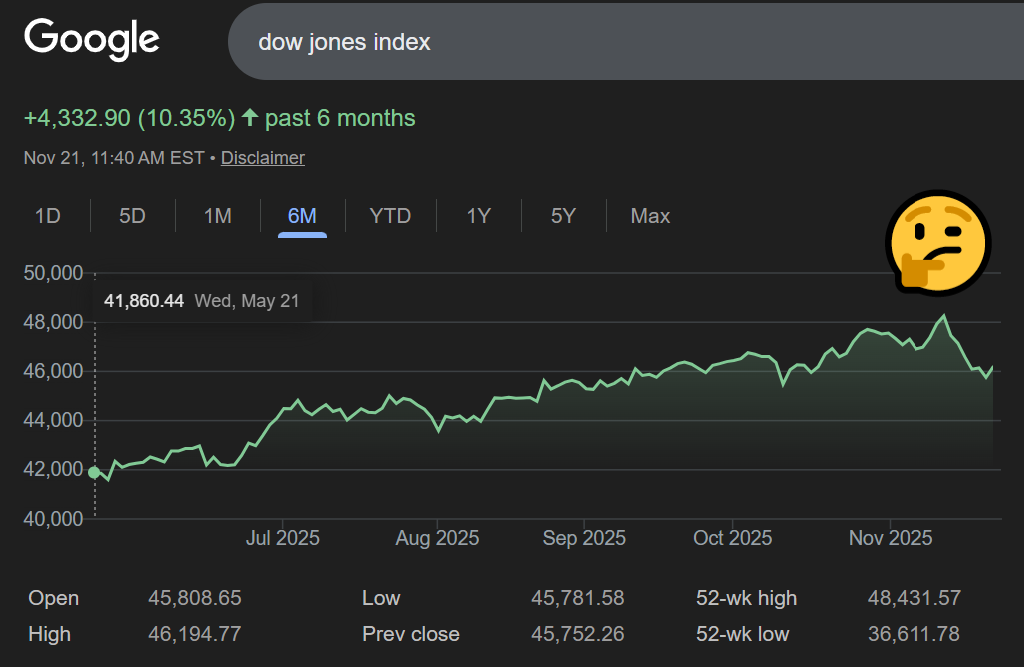
The recent dip aside, stocks have had a strong year. So why are some money people getting nervous?
You may have seen headlines about a guy named Michael Burry closing his hedge fund. Burry was a key player in The Big Short, a book and movie chronicling the build-up to the 2008 financial crisis. He was early in sensing something was wrong with the housing market and made heavy financial bets predicting a crash.
Obviously he turned out to be right. Lately he’s been sounding the alarm on AI firms, including Palantir and Nvidia, noting their stock value far exceeds the actual value of their goods and services.
One method used to check if a stock price is way out of line with reality is the price-to-earnings (P/E) ratio, where you divide the stock price by the company’s actual earnings per share. AI hype isn’t the first thing to push up P/E ratios, but it can be a sign that things are about to take a negative turn. P/E ratios haven’t been this high since the early 2000s dot-com bubble.
Whether Burry is right also comes down to a philosophical question about how to invest: the value approach or the growth approach. The value approach is more likely to follow P/E data and shy away from fast-growing stocks that may or may not have a bright future. Growth investing takes on a bit more risk and is looking for the future Googles of the world. Before freaking out about Burry’s latest move or writing him off as a curmudgeon, I’d recommend reading this piece for more perspective.
Speaking of AI…
We don’t yet know how much real value AI will contribute to the economy, but it needs a lot of computing power. You know what else requires a lot of computing power? Cryptocurrencies!
Things looked touch-and-go for a bit, but the crypto ecosystem mostly survived the FTX/Sam Bankman-Fried apocalypse. Now it might face a new challenge — AI’s surging popularity. Some of the firms using large amounts of computing power and electricity to approve crypto transactions are pivoting to AI.
Last week, Bitcoin mining company Bitfarms announced it was transitioning away from crypto operations and moving into AI. The surging need for AI computing power is also boosting the fortunes of the Texas-based crypto mining firm IREN. From The Wall Street Journal:
Miners have good reason to consider AI. They solve an increasingly complicated arithmetic problem to unlock bitcoin, but the difficulty has been increasing faster than bitcoin prices. Even with prices up from a year ago, mining profits have been declining.
It’s too early to say if this is a big trend, but if crypto and AI have to compete for the same resources, growth investors might favor the latter.
Ignore the “$2000 tariff checks” headlines
There is an obvious political upside to the President Donald Trump telling people he plans to send out checks to most taxpayers for $2,000. When the president makes such a proclamation, the media is going to report on those words. And because people like the idea of getting money, they’re going to click on those links to see what’s going on.
This circular interest cycle ignores the reality that the president can’t bypass Congress and send people a bunch of money. Even if he could, the tariff revenue will not cover the cost of the checks, even with a pretty rigid income cutoff, as noted here by the Tax Foundation.
At times, Trump has also argued the tariffs will bring in enough money to help to lower the federal government’s budget deficit. So far this year, the deficit is already at $1.8 trillion. Even if tariffs can help close that gap, the same revenue can’t be promised for two different goals. As of right now, congressional Republicans are too worried about deficits to approve an expensive round of stimulus checks.
John, your title set the tone. A strange disconnect between AI chatter and creeping doubts about its long‑term utility. Certainly, there won't be a $2,000 tariff rebate check, at least not until the administration overcomes the upcoming Supreme Court decision on the validity of how Trump has used IEEPA to enforce many of those tariffs.